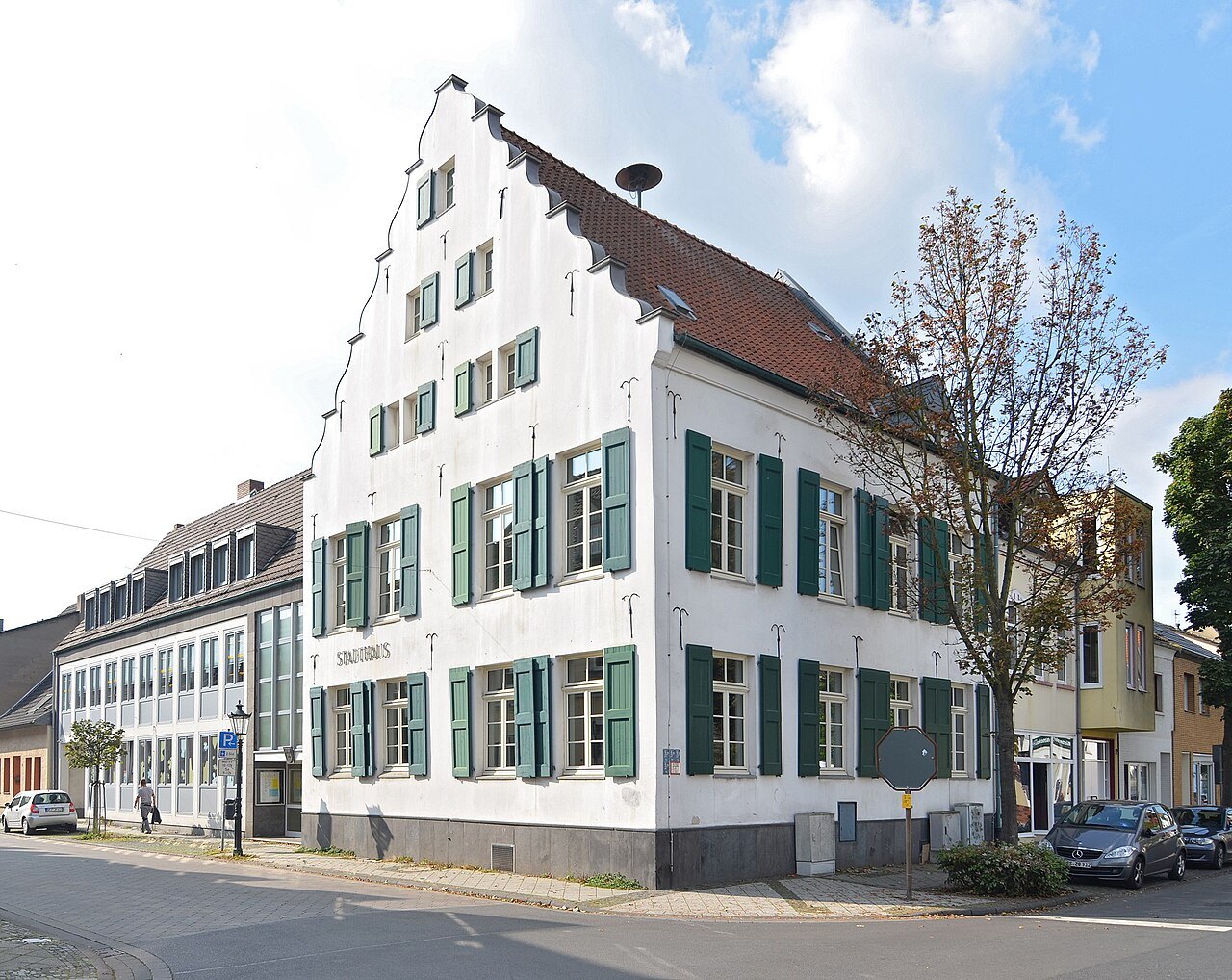

Orsoy is now part of Rheinberg and can be explored through its former fortifications and position beside the Rhine. Distinguishing construction periods and functions is worthwhile here. Not every riverside gate is medieval, and a tower may acquire a very different purpose after its military use ends. The municipal walking guide provides several concrete examples.
A gate serving flood protection
At Friedrichplatz, the settlement meets its access to the Rhine. According to the town brochure, the Rheintor was built in 1937–38 as part of strengthening the river embankments. Its historic appearance should therefore not lead to a medieval date. High-water marks on the river side give the structure a directly readable context.
Compare the marks with your own height without entering closed areas. This helps explain why an opening beside the river must be capable of being shut. During high water, follow current closures; sightseeing does not justify bypassing protective structures. Even at lower levels, river edges and passing vessels require attention.
From promenade to ramparts
A section along the Rhine promenade opens the view towards the river. The ramparts introduce another kind of boundary: a surviving landform rather than a continuous wall façade. Follow the published walk or current local signs. Understanding the line is more useful than finding the shortest connection across sensitive ground.
The municipal account also explains the structure called the Bär as a former sluice or weir with a flood-protection role. You do not need to grasp every technical detail at once. Begin by considering which movement of water such a structure would regulate and why it might remain necessary after a fortress ceased to function.
A tower with changing work
The Pulverturm was built around 1550 as a corner tower of the town wall and later served as a mill tower. That change makes it a useful final stop: a building can survive while its task changes. Notice the adjoining wall remains and examine the tower from a little distance.
For a short visit, these three subjects are sufficient: opening, rampart and tower. With more time, add further stops from the official walk. Include churches and other interiors only according to their current visiting arrangements. Finish by following a known public route back to the starting point; no Rhine crossing is required to understand this part of Orsoy's history.