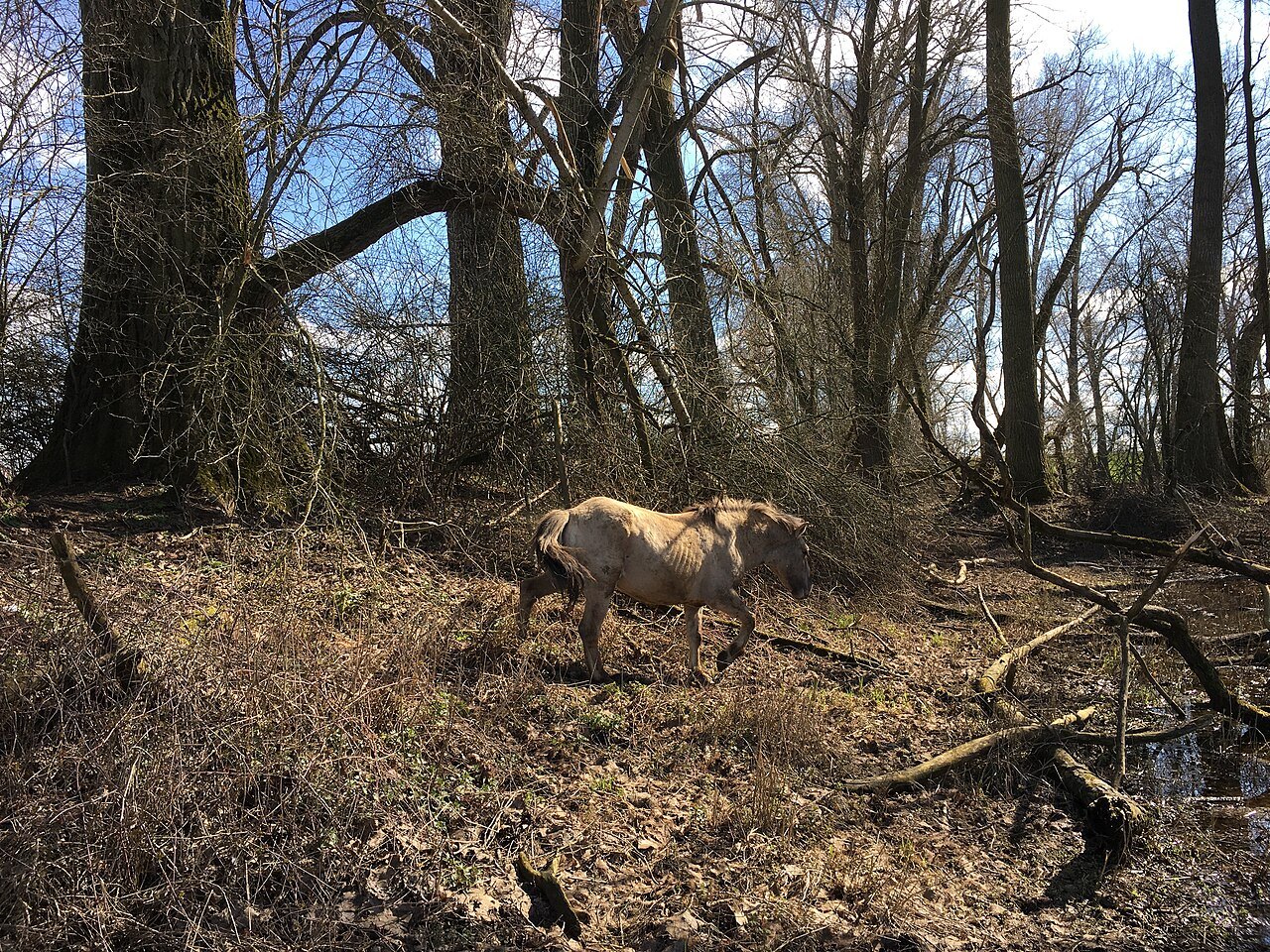
Millingerwaard, south of the Waal near Nijmegen, shows a river landscape allowed to change. Staatsbosbeheer describes newly created channels, floodplain woodland, open ground and freely grazing animals. For visitors, this has an immediate consequence: the landscape is not simply scenery around a permanently reliable circuit. A saved track may end at water on a later visit even if it previously worked without difficulty.
Freedom to explore has local limits
The official listening-route description states that roaming is generally permitted in Millingerwaard. This differs from many German reserves where visitors must remain on designated paths. It does not establish the same permission elsewhere in the Gelderse Poort. Read the instructions at the specific entrance, including temporary closures and rules affecting dogs or bicycles.
Even within an area open to exploration, not every visible line makes a sensible connection. Fresh banks, dense scrub and water can interrupt an intended route. Roaming means choosing a responsible way through; it does not guarantee that a particular destination can be reached directly. Turn back before the situation becomes difficult to assess.
Check water conditions before travelling
Staatsbosbeheer directs visitors to overlopen.info for current accessibility. Use this information together with local notices. A water-level figure on its own means little without a connection to the particular crossing concerned. Do not treat an old threshold in a travel report as a personal clearance to proceed.
Prepare three options. In suitable conditions, use the confirmed circuit. With restricted access, retain a shorter outward-and-return walk from the same entrance. If that is uncertain too, choose an explicitly accessible destination outside the affected area. The decision is then prepared in advance, rather than driven by a desire to justify a long journey.
Large animals are not a photography appointment
Horses and cattle contribute to vegetation management. They are not an encounter to engineer deliberately. Keep the distance required locally, do not feed them and avoid passing between animals and their young. If a group occupies the intended passage, wait well away or choose a permitted alternative.
A camera can distort your sense of distance: on the screen the animal becomes a subject while you are physically moving closer. Choose a standing position without the camera first. If appropriate distance allows only a wide landscape photograph, that is the suitable image for the circumstances. A close-up is not an essential part of the outing.
A landscape with several kinds of water space
From a clear position, distinguish the main river from channels, still waters and lower areas of ground. Not every visible body of water moves at the same speed or in the same direction. Examine these forms without entering them or testing an improvised crossing.
A useful note records location, viewing direction and visible connections between water surfaces. Label an interpretation explicitly as an interpretation. On a later visit, this helps establish whether water genuinely occupies a different place or whether the apparent change comes from another viewing angle.
Allow for a different return
Wear footwear suited to unsurfaced ground and carry water and weather protection. Time reserves must cover a longer return if one connection proves unusable. For a group with limited walking ability, a specifically confirmed suitable path matters more than the promise of free exploration. The value of the visit lies in noticing change and adapting your plan to it, while retaining enough daylight and energy to return comfortably.