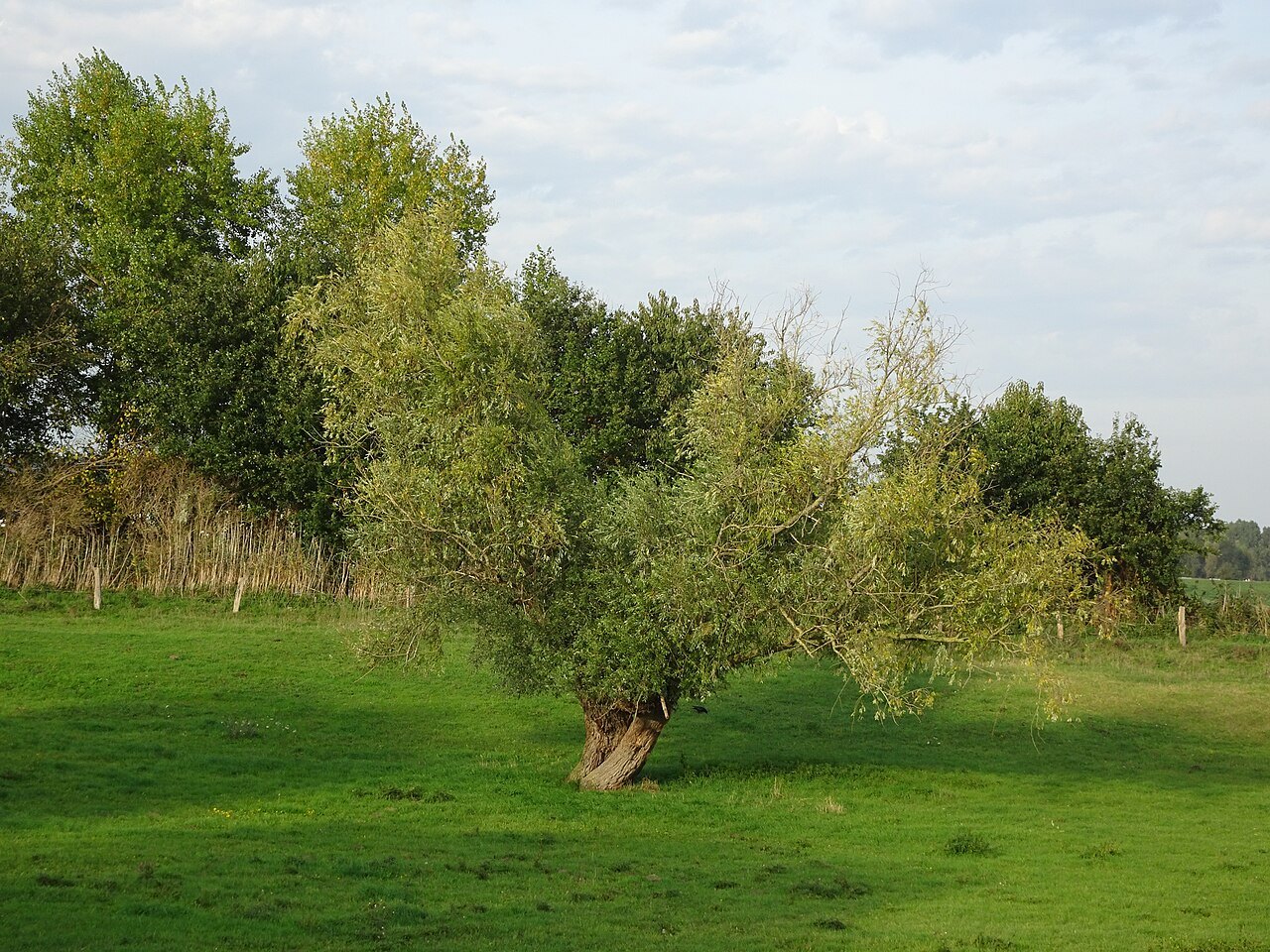

Salmorth shows a different side of the Kleve area from its wooded hills. Open space defines the view here. The local nature conservation centre places the reserve between Griethausen and the Dutch border and describes extensive grassland with relatively few trees. A visit therefore involves studying the landscape and using permitted connections, without assuming that every visible riverbank can be reached.
Establish access first
Before leaving, choose a clearly identified starting point and check a current map for publicly usable roads and paths. An aerial photograph also shows agricultural tracks. It can help with orientation, but it does not establish rights of access or override signs. If a route ends at a gate, going around by a permitted route is part of the outing.
Higher Rhine water can produce conditions unlike older photographs. Check local notices and information at the entrance. A flooded section is not an invitation to divert across adjoining grassland. For a flexible day, identify a second, clearly accessible observation point outside the affected area before setting out.
Grassland is more than a green surface
The reserve managers identify meadows, pastures, flood hollows and the banks of the Griethausen old Rhine channel as important components. Some ground is managed less intensively. However, an individual flower or the length of the grass does not reliably reveal the management regime of a particular field.
Use a quiet stop to compare features. Which patch lies slightly higher? Where does water collect? Where do shrubs provide cover? Sketch the sequence from foreground to background. This can develop a more precise understanding than hunting for a supposedly ideal photography position. Leave fences, gates and waterside vegetation undisturbed throughout.
Observation without pressure to approach
Binoculars let you watch animals from a distance. If a bird cannot be identified, its behaviour and location may still be interesting: is it feeding on the ground, resting on water or using a raised perch? Leave an uncertain identification uncertain. Completing a species list is no reason to leave the path.
Allow enough time to return, particularly if the outward journey enjoyed a following wind. Standing still at an exposed spot can feel cold even when walking was comfortable. A sitting mat for an existing permitted stopping place and another warm layer may prove more useful than additional heavy camera equipment. Finish with a clear impression of two landscape sections instead of rushing through a collection of supposed highlights. A short written note about water, vegetation and visibility will also make a later visit easier to compare.