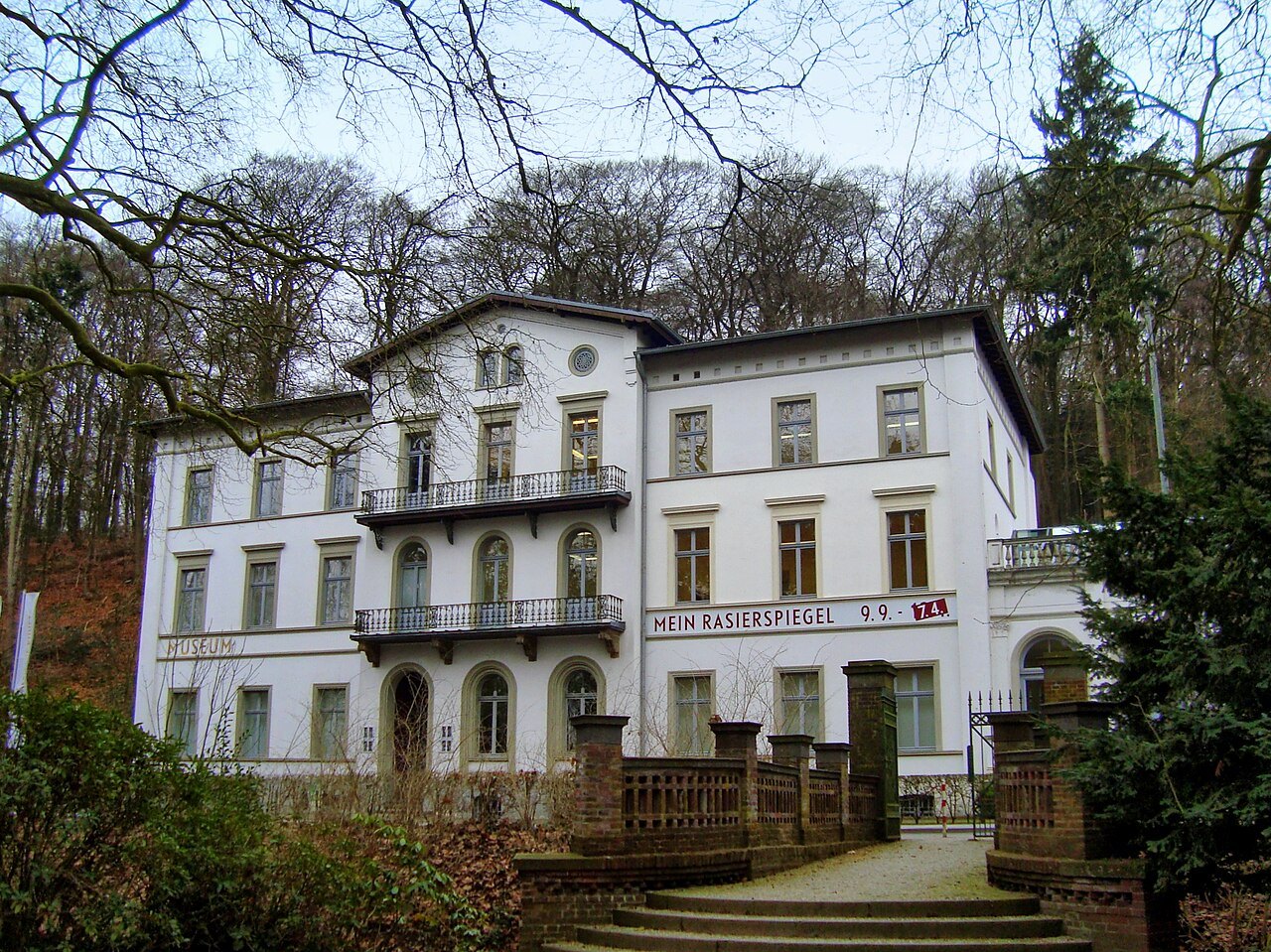

At Museum Kurhaus Kleve, looking begins before the first artwork. The long building was not designed as a neutral exhibition container; it grew out of Kleve's history as a spa town. Its different sections and later uses help explain why a visit can be more than a succession of pictures on walls. Considering architecture alongside the collection gives even a limited visit a clear focus.
Read the building from outside
The museum's history distinguishes construction phases in 1845–46 and 1872–73. The former spa hotel, the halls in the middle and the Friedrich-Wilhelm-Bad form the principal parts of the ensemble. Before entering, notice changes between sections, sequences of windows and the relationship with the garden. Try to read these parts as one connected building without assigning each an assumed present-day exhibition function.
A photograph of the exterior can later help you place yourself: where in this long building have you just been standing? In a reused structure, knowing the outer shape makes the internal sequence easier to understand. You do not need to memorise a floor plan. The interesting distinction is between a room that encourages you to pass through and one that invites you to stay.
Separate the collection from today's display
The subtitle “Ewald Mataré-Sammlung” has a specific background. A substantial portion of the artist's estate came to Kleve in 1988 and helped bring about the museum's foundation; it opened in 1997. The museum's own inventory shows the range of this material, including sculpture, graphic work, designs and archives.
An object appearing in the online collection does not necessarily mean it will be on display when you visit. Check the current exhibitions if one particular work is the reason for your journey. For a more open visit, a question can guide you through the rooms: how does an observed animal become a simplified artistic form? Or how does a change of material alter the effect of a similar subject?
Choose two works that allow a comparison instead of ticking off as many names as possible. Look first without extensive reading, then consult the title and explanation and notice what changes in your perception. A short note about form, surface or scale can preserve more than a large set of photographs with no accompanying thoughts.
A studio is a different kind of space
The history of the house includes the reconstructed Joseph Beuys studio in the Friedrich-Wilhelm-Bad. A studio raises questions different from those of a gallery: how is work organised spatially, what is a tool and what is an artwork, and what does the later reconstruction tell us? Use the explanation to establish which period is being presented. “Reconstructed” and “preserved unchanged” make different claims.
For children, comparing a working space with a display space can make a museum visit more tangible. Let them describe what they notice before offering an explanation. This needs neither a guided tour nor prior knowledge, but it does require consideration for others and observance of the distances requested around objects.
End with a deliberate pause
Do not make every available exhibition compulsory. When attention starts to fade, a break is more useful than rushing through additional rooms. Ask about cloakrooms, seating and suitable circulation before entering if these affect your visit. Looking back at the façade afterwards can reveal how closely the experience of art and the history of the building belong together here.