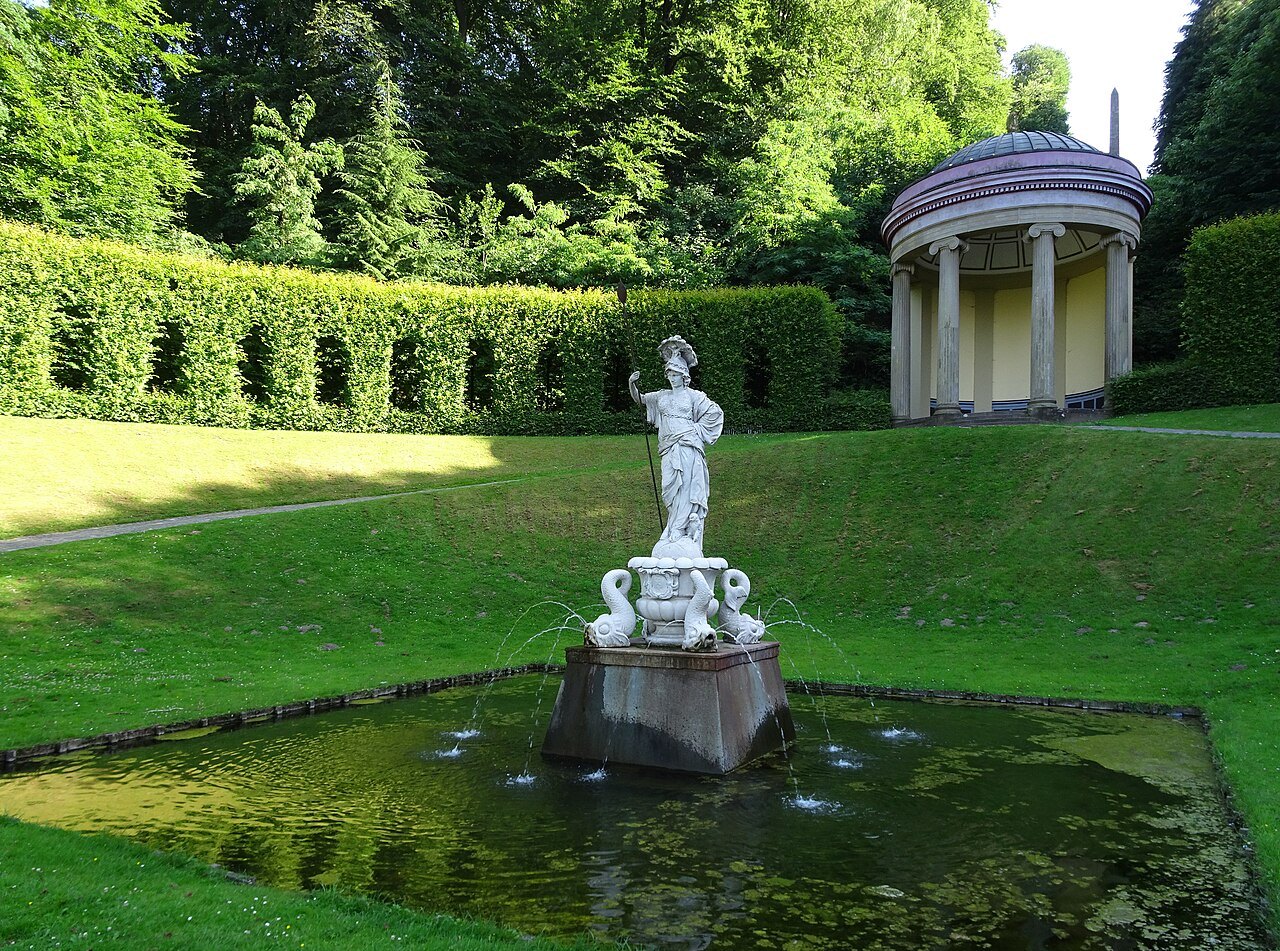

A garden in Kleve does not necessarily stop at a fence. The historic grounds connect carefully arranged spaces nearby with more distant points in the landscape. Expecting only flowerbeds means missing an important part of the design: paths and planting influence when a subject appears, how long it remains visible and the direction from which you approach it. A few deliberate viewpoints are enough for a first exploration.
A landscape made at different times
Johann Moritz von Nassau-Siegen shaped the surroundings of his residence town in the seventeenth century. The amphitheatre and avenues directed towards particular landmarks belong to that history. The Forstgarten arrived later, in the late eighteenth century, and subsequently acquired a landscape-garden character through Maximilian Friedrich Weyhe. These grounds are not the product of a single design surviving unchanged.
That distinction is useful on a walk. A straight water axis, a curving connection and a group of apparently isolated trees need not express the same intention. Avoid forcing every feature into one design category. Restoration also affects what can be seen today. For precise dates, official explanations and on-site panels are more dependable than assuming that a particularly large tree must date from the garden's foundation.
Three ways of looking
Begin where a clear axis is visible. Stand in the middle of it, then move to one side. Which features line up behind each other, and which lose their connection? This small change in position helps explain why some historic garden views appear especially ordered from one particular place.
Next, find a less direct stretch and notice how a path disappears behind planting. The next space is not revealed all at once. For a third observation, look across an open area towards a group of trees. Compare the solid outline of the crowns with the empty ground in front. None of these exercises depends on flowers being in bloom or on bright sunshine. They work equally well as quiet observations on a cloudy day.
Choose one connected section
Concentrate either on the terraces and water features or on the Forstgarten. Add another area while the group still has the attention for it. With children, a small task such as spotting repeated lines or different leaf shapes can be more engaging than continually announcing the next attraction.
Tiergartenstraße is part of the real setting of this garden landscape. Use appropriate crossing points and do not treat areas on opposite sides as one traffic-free park. Where mobility matters, consider the route separately from the view you hope to reach: a viewpoint that looks close on a map may involve a climb. A shorter section that everyone can explore together still makes a complete garden visit.