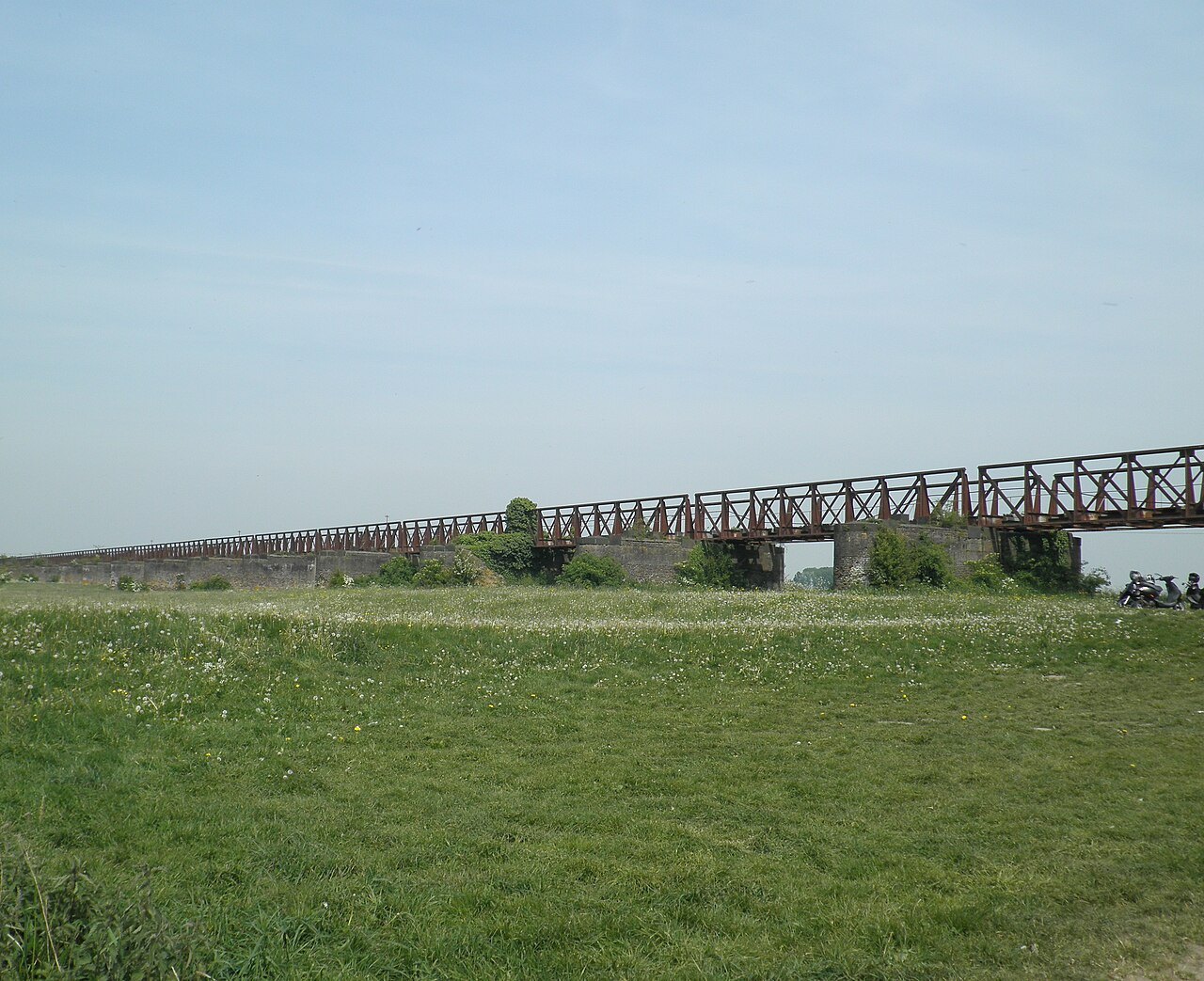

The disused railway bridge at Griethausen is immediately recognisable by its metal framework. A visit does not require getting onto the structure, however. From publicly accessible ground beside the water, you can better understand how it crosses the old Rhine arm and the adjoining lowlands. Distance makes the construction clearer and avoids treating a former railway alignment as an automatically approved walking route.
One bridge with two tasks
Kleve's tourism information dates construction to 1863–65 and identifies the Rhenish Railway Company as its builder. The bridge belonged to the connection from Cologne through Krefeld and Kleve towards Zevenaar. It was therefore part of a wider transport network rather than simply a local crossing between two banks.
The distinction between the main span over the old Rhine arm and the long approach structure is especially revealing. The official description gives lengths of 102 and 464 metres respectively. Most of the structure therefore does not simply sit above the water visible today. This helps explain why a bridge in a river landscape has to account for more space than the width of the water on one particular day.
Follow the framework with your eyes
Choose a position from which several sections are visible. Trace a horizontal line and compare it with the diagonal members. Without attempting an engineering calculation, you can observe how repetition gives the structure its order. A view close to side-on reveals the sequence differently from an oblique view along its length.
For photographs, first include the bridge within its surroundings, then select a detail of the framework. This keeps the pattern connected to the larger structure. A reflection is another possibility, but it is not a reason to step onto a steep or closed section of bank.
Disused does not mean freely accessible
The structure has been protected as a monument since 1984. Heritage status, technical maintenance and visitor access are nevertheless different matters. Do not use old photographs or wording in excursion descriptions as permission to enter. Follow only current local access arrangements. This suggested visit deliberately remains beside the water.
If you wish, combine the bridge view with a short walk through Griethausen. Check the actual foot route instead of following the former tracks. The bridge provides a way to consider changing uses of transport infrastructure: something that once enabled movement is now itself an object of observation. That change of role is part of what makes the monument interesting.