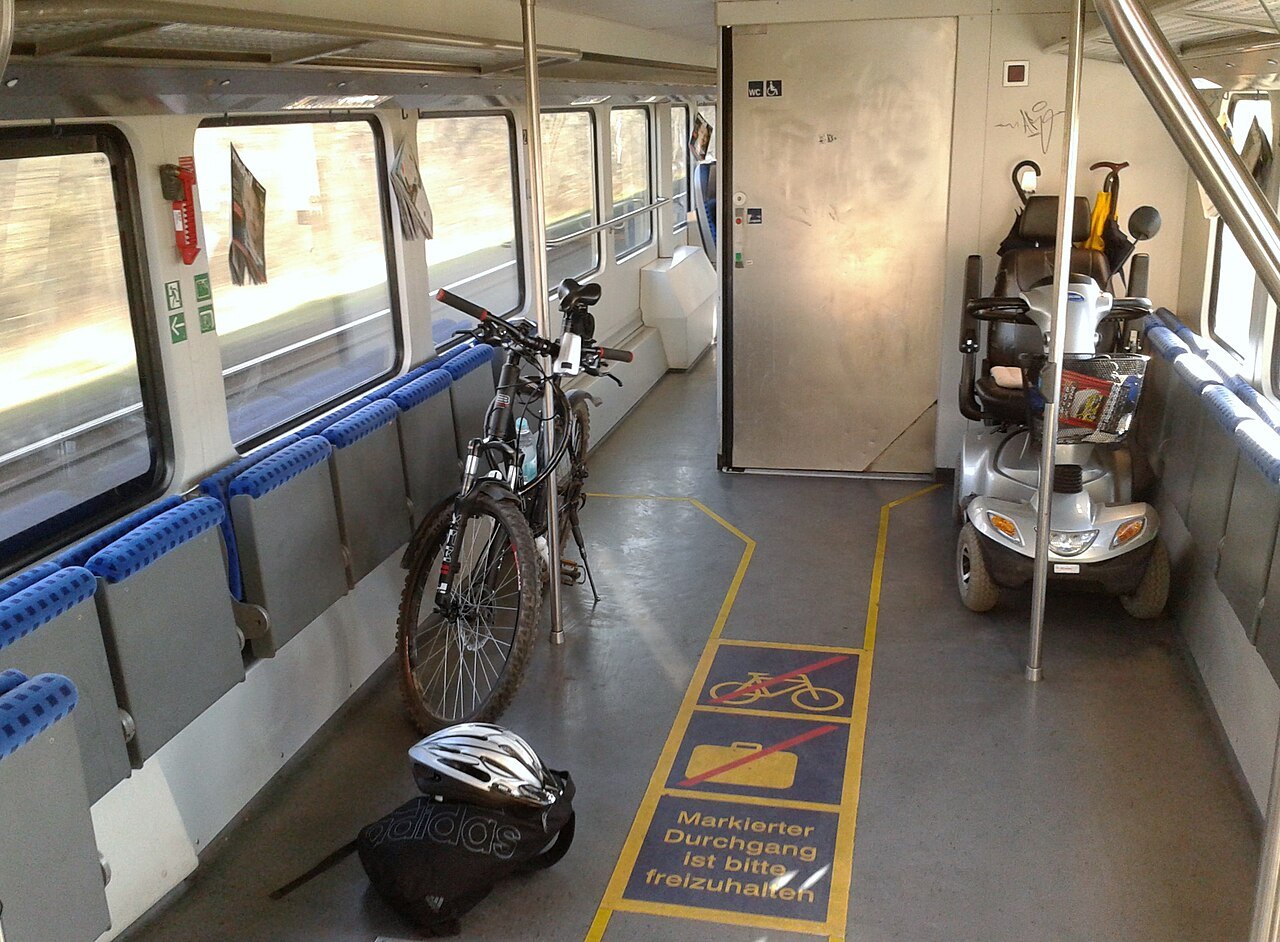
Combining bicycle and train allows a ride to run from one place to another rather than form a circuit. The organisational work does not disappear; it moves to the transitions. A journey plan for one person without a bicycle is not yet suitable for a group with loaded bikes. Check train type, carriage conditions, transfers and station access together before choosing the distant end of the cycling stage.
Check passenger travel and bicycle carriage separately
A ticket for you does not automatically establish whether the bicycle is allowed or which additional ticket it needs. German regional services can have local fares and operator conditions. Deutsche Bahn also states that regional transport offers no general guarantee of bicycle carriage. Buying a bicycle ticket therefore does not create an available space.
Long-distance and international services can add reservations and other requirements. Check every leg rather than only the first train. A journey that works on the first section may fail on the second through a missing reservation or different vehicle rule. Save relevant confirmations where they remain available offline.
Examine the Dutch section independently
NS specifies time restrictions, an additional bicycle ticket and designated spaces for ordinary bicycles. Its standard carriage conditions exclude cargo bicycles and bicycle trailers. Check current details and exceptions before travelling, especially when combining German and Dutch services. One company's rules do not automatically apply to every cross-border connection.
Replacement transport is another separate issue. NS states, for example, that bicycles cannot be carried on NS buses. Check engineering works and short-notice changes instead of relying solely on an earlier saved itinerary. If the cycling stage ends across the border, such a change can affect the whole return.
Calculate transfers with a loaded bicycle
A short platform change on foot can take longer with a bicycle, bags and several people. Check lifts, ramps and the route between tracks. A listed lift may be unavailable or too small for the particular bicycle. For a heavy e-bike, stairs are not an equivalent fallback when nobody can carry it safely.
Choose a longer transfer when unfamiliar with the station. Suppose two trains are eight minutes apart. Alighting, reaching the lift, possibly waiting and finding the bicycle area all consume part of that time. A nominally valid connection may be impractical. With children, also ensure that nobody is left alone on the wrong platform.
Organise boarding as a shared procedure
Agree beforehand who handles each bicycle and bag. Remove panniers where required for the intended storage arrangement and keep doors and aisles clear. Follow staff instructions and use marked spaces. A group has no entitlement to displace other important uses of a multipurpose area.
Agree what happens if not every bicycle fits. Boarding without a plan and hoping the rest follow can separate the group unnecessarily. Waiting together for a suitable later service is often simpler. That later option must still exist and fit the day's schedule, however.
Do not discover rail only as an emergency solution
Where the route permits, taking the longer train journey at the beginning and cycling back towards the starting area can work well. Capacity uncertainty then occurs before, rather than after, an exhausting day. The outward service and a possible later departure still require checking.
If the train comes at the end, do not make the last theoretically possible service the normal plan. Leave time for at least one genuinely usable alternative and check its bicycle conditions. Afterwards, record platform access and luggage handling briefly. The next combined journey can then be planned around concrete procedures rather than a connection list alone. This is particularly valuable for larger groups, where one awkward lift or missed transfer affects several people at once.