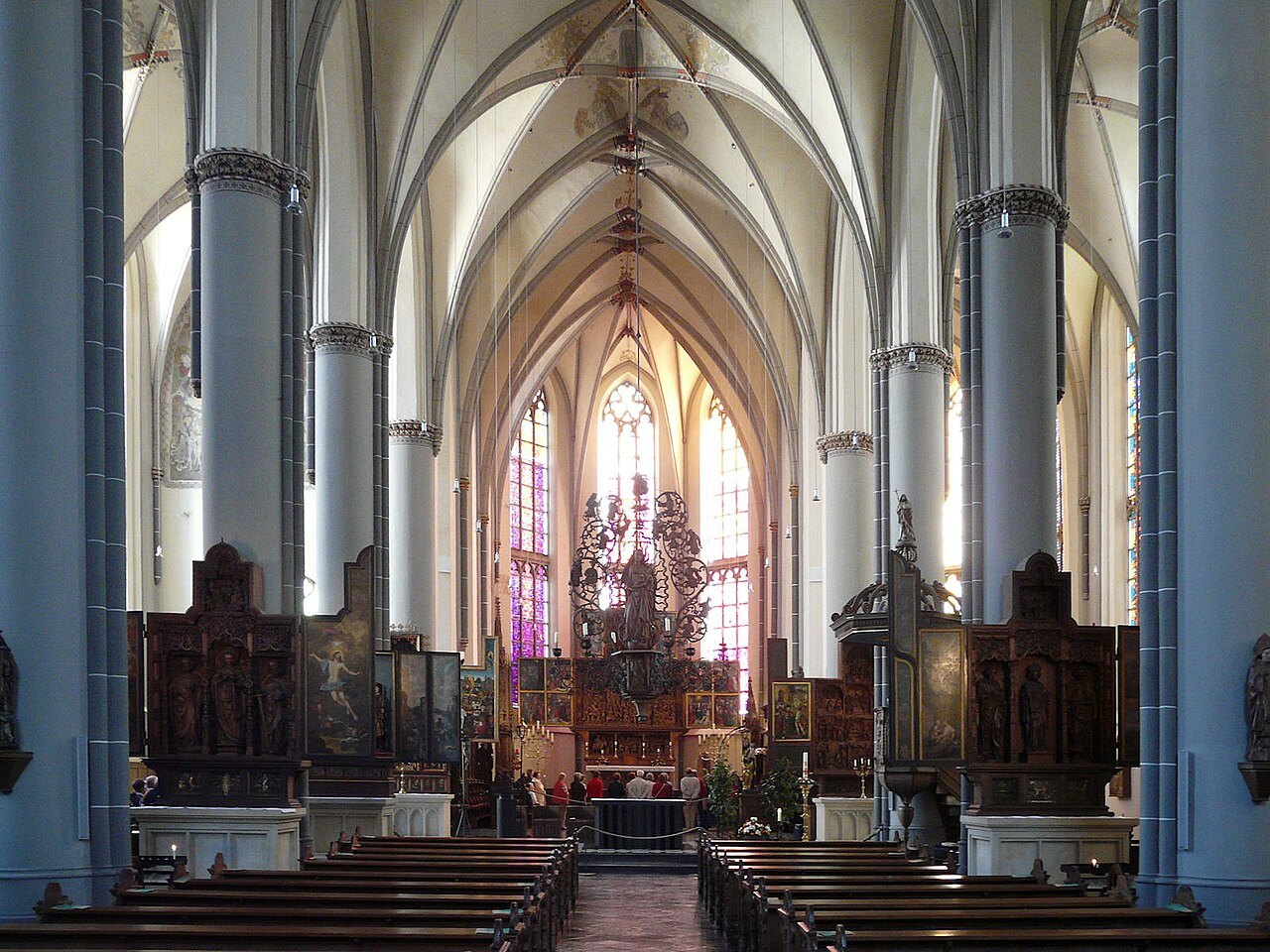
At St Nicolai in Kalkar, you need not try to understand every artwork on a first visit. A church full of visible details can scatter attention rather than sharpen it. Begin with a deliberate selection: an impression of the space, one detail seen closely and one question answered through the available interpretation. This approach works without extensive preparation.
Settle in before choosing
Check the official visitor information and respect services or other church activities. If an area is closed, do not look for another passage into it. Your visit need not follow an exhaustive list. A few accessible views are enough for attentive observation.
Start somewhere you will not obstruct other people. Which areas are especially bright, which shapes repeat, and where does your eye naturally travel? Then select a work or architectural feature with a readable explanation. If useful, note its name so that you can research that exact object later instead of confusing it with something similar.
From an overall impression to one detail
For a figurative scene, first describe the arrangement. Who occupies the centre, which gestures connect the figures, and which objects help tell the story? Read the label afterwards. This reveals the difference between your initial interpretation and what the explanation actually identifies. A supposition is not a failure provided you do not pass it on as established knowledge.
A second detail is enough for comparison. Does it feel calmer or more animated, and does light or distance change that impression? Do not use flash or additional lighting without explicit permission. A dark detail does not have to be illuminated for your photograph. Looking in person and later studying an official image can complement one another.
Take one question away
With children, a short task often works better than a long explanation. Ask them to find a repeated shape without moving hurriedly among other visitors. Finish before concentration fades. For adults, an unanswered question can be a useful ending: what is the object made from, who commissioned it, or how has it been preserved? A specific object description is more likely to answer than general assumptions about church art. Returning to the town, you then carry away one clear impression rather than an indistinct catalogue.