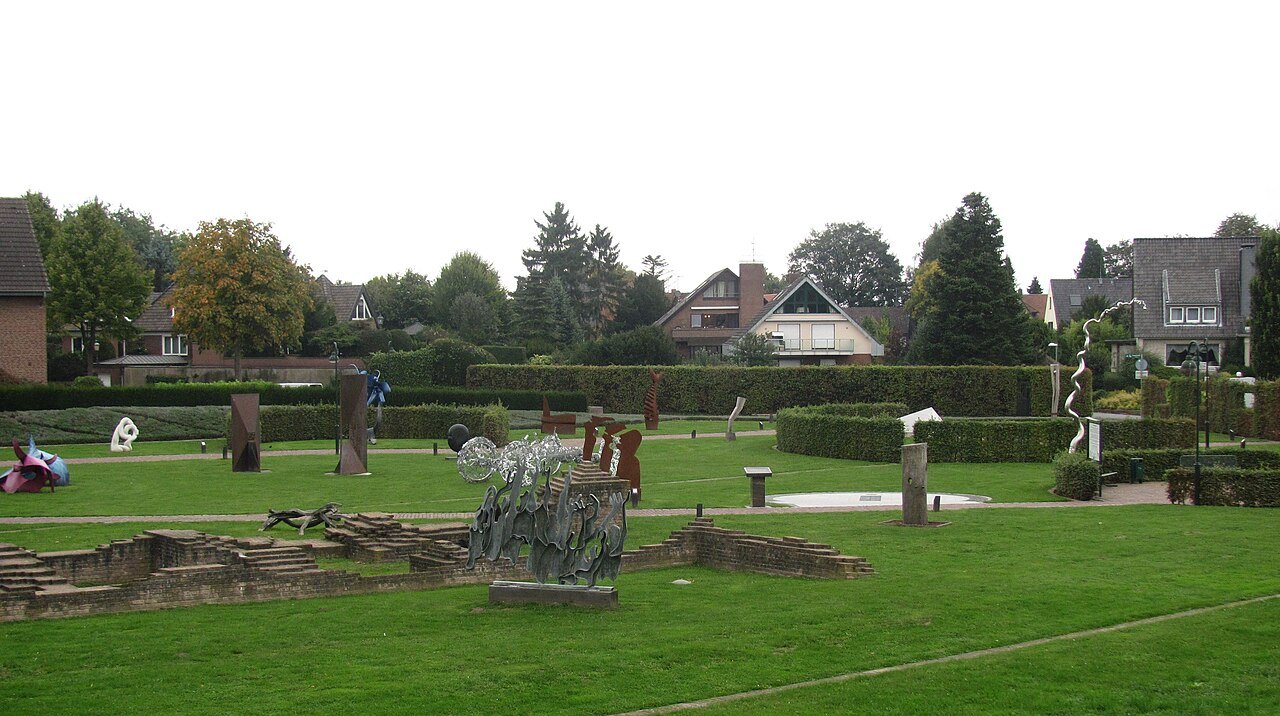

At Rees's sculpture park, art meets everyday outdoor space. The municipality places the park beside the medieval town wall near Museum Koenraad Bosman. Changing exhibitions mean that an older photograph may not show today's selection. You therefore need no fixed list of every work. Looking carefully at three objects can produce more discussion than hurrying past the entire display.
Look before reading the title
Choose a work whose form attracts or puzzles you. Describe it without interpretation: its apparent material, outline, open and closed areas and relationship with the ground. Move a little along permitted paths and notice what changes. A narrow body may look broad from another side; an opening may suddenly matter more than the solid mass.
Only then read the title and explanation. Does the title confirm your first impression or send it in another direction? There need not be one correct emotional response. Nevertheless, distinguish a personal reaction from a documented statement by the artist. With children, it helps to say that a shape reminds you of something without necessarily representing it.
The setting contributes
Next consider the background. Wall, sky, trees and neighbouring works influence how clearly a sculpture stands out. For photographs, compare an image with plenty of surroundings and a tighter view. Both are valid but convey different things about the work.
Outdoor placement does not automatically permit touching or climbing. Follow the individual guidance. Even a form resembling a seat may be a vulnerable artwork. Keep routes clear for passers-by, and avoid turning a children's observation activity into a race between objects.
Visit a changing exhibition consciously
The municipality publishes information about the current exhibition. Check it if you want to see a particular work, and do not mistake an earlier brochure for the present display. For an unplanned walk, make your own small selection: a figurative object, an abstract form and something you cannot initially classify. Note their names if you want to read further later. Your memory then stays specific even when the exhibition has changed by the next visit.