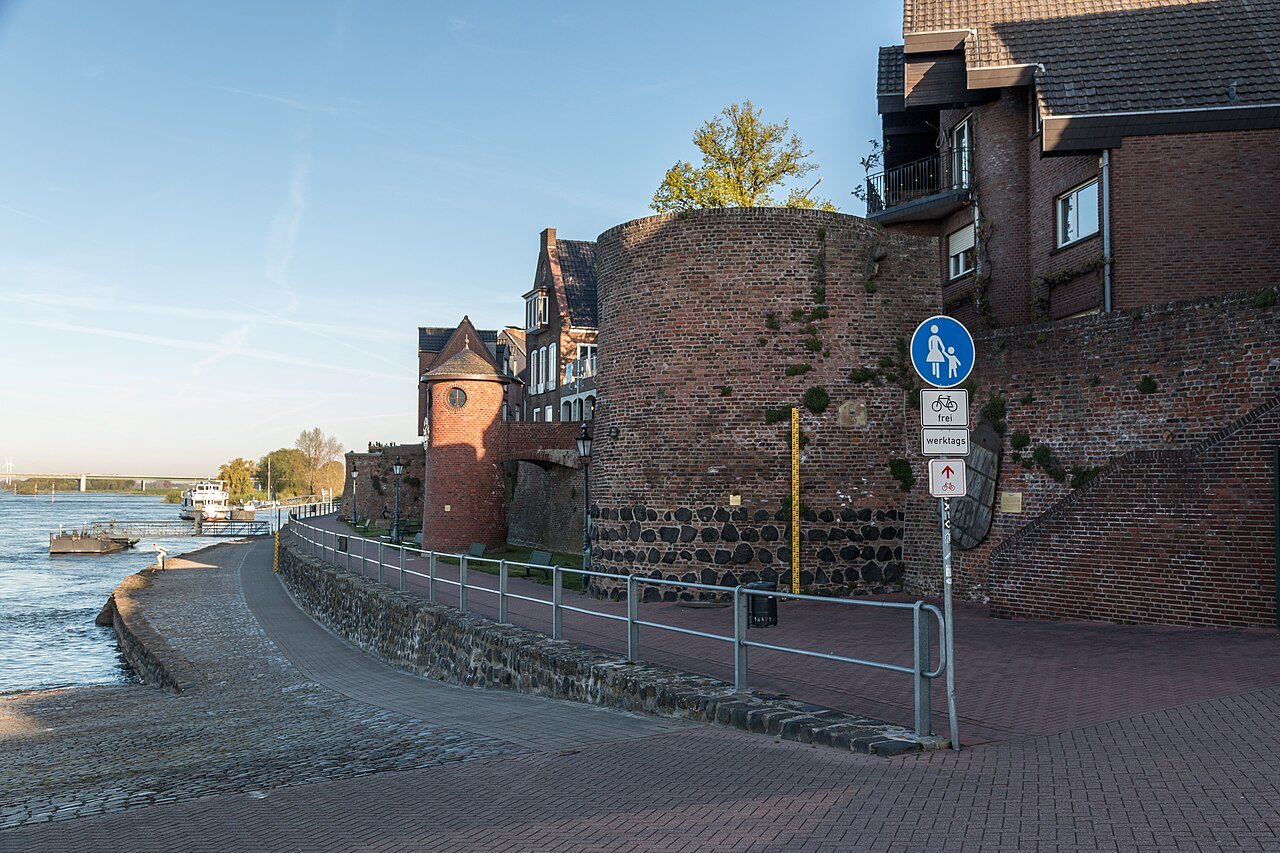

The Rhine gives children plenty of movement to watch: passing ships, changing reflections and a townscape shaped by the river. None of this requires reaching the water's edge. Choose a position on an established public route with separation from the water, without treating the river as part of a playground. A quiet observation task helps focus attention.
Choose the position before the activity
Make sure the group can stand comfortably without obstructing cyclists or pedestrians. An existing barrier does not replace supervising children. If a riverside path is closed, flooded or damaged, choose somewhere else. Do not walk around a closure because the desired view lies beyond it.
Agree clearly that nobody moves closer to the water alone. Dropped objects are not pursued. Avoid tasks involving throwing things into the river or collecting from the shore. Choose a position from which the entire activity can be completed without moving towards the edge.
Look closely at one vessel
Choose one passing vessel together. What shape is it, where is the steering area, and which parts remain in a fixed relationship? Let children describe it before asking them to name a type of ship. If the cargo is not visible, leave that question open. A closed hold does not reveal its contents.
Then compare the moving vessel with a fixed point on the opposite bank. This makes movement easier to understand than guessing its speed. Speed cannot be established reliably without measurement. Nor does the visible surface of the river provide a dependable assessment of conditions beside the bank.
Use the town as a second subject
In Emmerich, prominent church buildings can shift attention from the water to the town. Find a tower and follow its shape from top to bottom wherever visible. This provides another activity when no vessel is passing. Finish before waiting turns into restless wandering. A short river observation with clear boundaries is a complete part of an outing and needs no descent to the shore.